An appraisal report (taxatierapport) is the validated valuation Dutch lenders lend against. Here is what it costs, what it contains, how long it stays valid, and what changes on 1 April 2026.
Appraisal Report in the Netherlands: Cost, Contents and What Changes in 2026
JH
Door Justin Hooker
13 minuten leestijd Laatst bijgewerkt op 1 oktober 2026
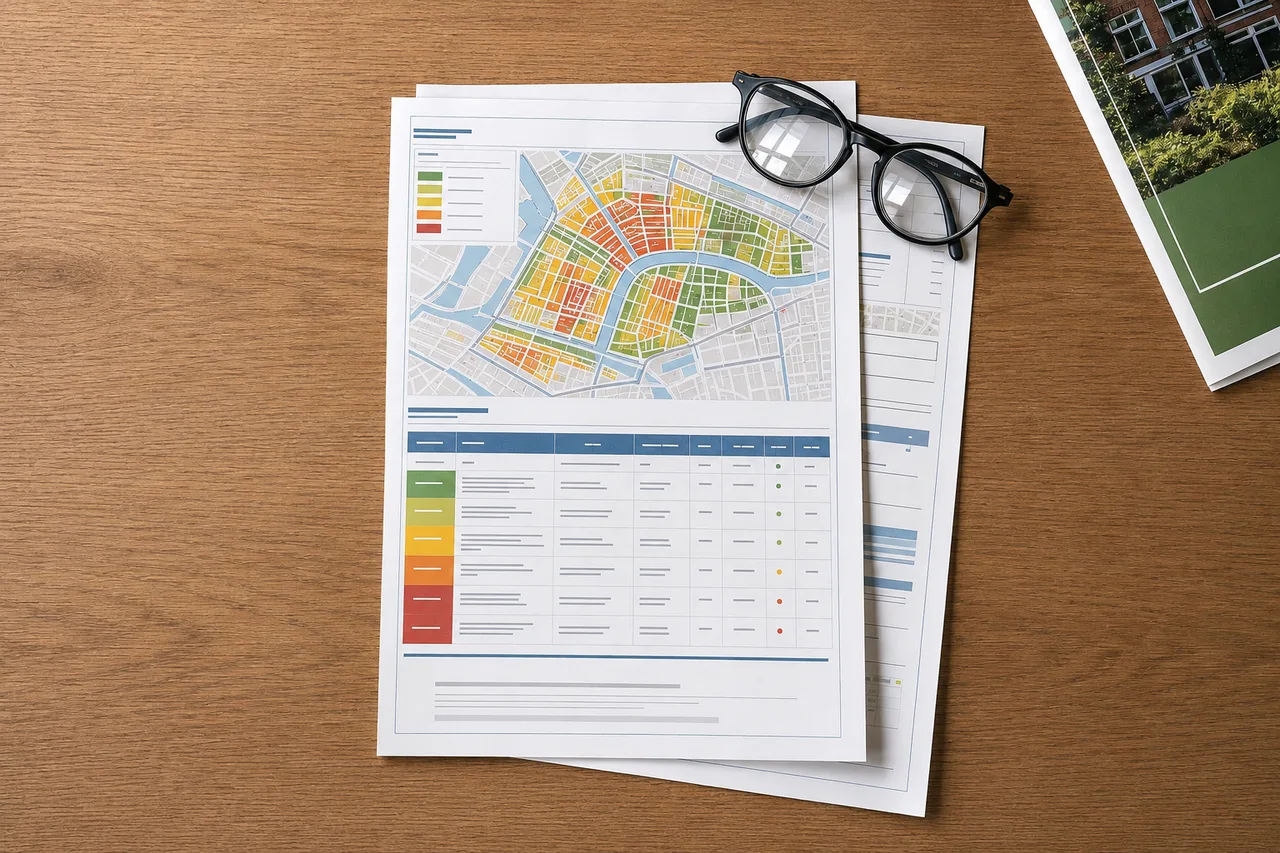
An appraisal report, in Dutch a taxatierapport, is an independent written valuation of a home, prepared by a registered appraiser and, for a mortgage, validated by an institute such as the NWWI. Understand the home's value before you bid: the report itself only arrives after your offer is accepted, and it says nothing about whether that offer was logical.
Key takeaways
- An official appraisal report in the Netherlands typically costs between €550 and €1,000, depending on how many hours the appraiser spends on the file (Hypotheker).
- Per NVM, the report documents more than market value: it also covers the legal, structural and sustainability aspects of the home.
- The NWWI validates reports from affiliated appraisers and checks that the value is sufficiently motivated and substantiated.
- From 1 April 2026, foundation risk gets a heavier role: the KCAF foundation-risk report is added to and validated within the taxatierapport, as part of the updated NRVT model.
- Market backdrop: in the fourth quarter of 2025, NVM agents sold 47,600 existing homes at an average price of €502,000 (up 3.9% year-on-year), with homes on the market for 28 days on average (NVM quarterly report).
What is an appraisal report?
In the Netherlands, an appraisal report (taxatierapport) is a validated document in which a registered appraiser substantiates a property's market value, and the NWWI (Nederlands Woning Waarde Instituut) is the institute that validates these reports and checks that the value is sufficiently motivated and underpinned. The appraiser is a certified, impartial professional who, unlike an aankoopmakelaar or verkoopmakelaar (the buyer's or seller's agent), does not represent a party in the deal. The report carries weight because of that independence: a Dutch bank does not lend against a price you negotiated, it lends against a value an outsider can defend. There are two variants in practice: a validated report, the only kind a lender accepts for a mortgage, and an unvalidated report used for purposes outside financing. If you want the plain-Dutch background first, our taxatierapport glossary and the piece on why you need an appraisal report both help.
How much does an appraisal report cost in the Netherlands?
An official appraisal report in the Netherlands typically costs between €550 and €1,000, depending on how many hours the appraiser spends on the file and which firm you use (Hypotheker). Larger properties, complex ownership such as erfpacht (the leasehold construction common in Amsterdam), a Vereniging van Eigenaren with deferred maintenance, or tricky foundations push the bill toward the upper end, because they demand more research hours. On top of the appraiser's fee, an NWWI-validated report carries a fixed validation contribution per file, usually rolled into the final invoice. Only a validated report can be used to apply for or refinance a mortgage, and almost every Dutch lender requires that. For an unvalidated purpose, such as a WOZ objection or a private value check before you speak to a financial adviser, a lighter and cheaper report is usually enough. Line this up early against your mortgage quote so the timing works.
Start with a free Walter account to see a market-value indication for your target home before you book an appraiser, so you walk into the appointment with your own anchor instead of waiting for the bank's.
What is included in an appraisal report?
A Dutch appraisal report bundles the market value with the legal, structural and sustainability findings, written up in a fixed format set by the appraisal sector and updated by the NRVT (Nederlands Register Vastgoed Taxateurs) for 2026. The appraiser visits in person, typically 45 minutes to an hour, and records everything in a structured document. A current taxatierapport contains:
- Address, kadastrale data and ownership form (full ownership or erfpacht), verified via the Kadaster
- Property description: type, year of construction, layout, gebruiksoppervlakte (usable floor area) and volume per the NEN 2580 measurement standard
- Condition and installations observed during the on-site visit
- Legal and zoning context: bestemmingsplan (zoning plan), monument status, VvE situation
- Comparable transactions with a per-reference explanation of why each home is genuinely comparable
- Energy label and sustainability features, now a standard section
- Foundation risk class drawn from the KCAF foundation-risk report (the primary source from 1 April 2026)
- Final market value plus any special assumptions the lender should know
The report is more than a price tag: it is the substantiation of that value, with the data held accountable for it. For the lender it is the collateral anchor; for you it is an after-the-fact check on the koopsom you already committed to. If comparables are new to you, our pieces on why reference properties matter and what determines a home's value are good starting points.
How do you write an appraisal report (and why you don't, as a buyer)?
A formal appraisal report is not something a buyer writes; it is produced by a certified appraiser bound by the register rules of the NRVT (Nederlands Register Vastgoed Taxateurs). The appraiser opens with the address, kadastrale data and ownership form, then documents the on-site observations, builds the value argument from recent comparable transactions, and concludes with the market value plus any special assumptions. For a validated file, the NWWI then reviews whether the value is sufficiently motivated and underpinned, and only then does the report receive a validation code that lenders accept. If you want your own structured value picture before you bid, that is not the appraiser's job: it is what a comparative market analysis, the Walter CMA, is built for. Honestly: until the updated 2026 model takes effect, two appraisals on the same home could read like two different documents; the new NRVT model tightens that up.
That is the whole point. The appraiser substantiates a price that already exists; the buyer has to dare to test that price first, as Walter's CTO puts it:
"The appraiser simply validates an existing price, but it is up to the buyer to have the confidence to verify it independently."
Marcel de Graaf, CTO Walter Living
What are the three types of appraisal reports?
In Dutch practice there are three reports that matter, and the NHG (Nationale Hypotheek Garantie) accepts only one of them for a guaranteed mortgage. First, the validated taxatierapport: an on-site appraisal reviewed by the NWWI, given a unique validation code, and the only kind virtually every lender accepts for a mortgage or refinancing. Second, the unvalidated report: the same on-site work without institute validation, used for purposes outside financing such as a WOZ objection or a private value check. Third, the desktop-taxatie: a lighter, model-based valuation without a physical visit, accepted by some lenders for newbuild files or limited mortgage increases. The rules differ per lender and per NHG situation. In most buyer cases the choice is not yours: the lender prescribes the report type, and you receive a mortgage offer based on it. If you are weighing the model-based route, our explainer on the desktop valuation sets out what it can and cannot do.
What are the red flags on an appraisal report?
The clearest red flag on a taxatierapport is an unfavourable foundation risk class, which from 1 April 2026 comes straight from the KCAF (Kennis Centrum Aanpak Funderingsproblematiek) foundation-risk report and can pull the appraised value down. Watch for special assumptions that quietly rewrite the basis of the value, for example an assumed renovation that has not happened yet. Check the comparable transactions: if the reference homes are not genuinely similar in type, size, location or condition, the value argument is weak, even when the final number looks fine. A report older than three to six months is another flag, because lenders cap how old a valuation may be. And a large gap between the appraised value and your koopsom is not automatically wrong, but it is a signal to understand before the notarial transfer, not after. If foundation risk worries you, read our guide on recognising it before you bid.
How long is an appraisal report valid and how long does it take?
After the appraiser's site visit, the report is usually ready within a few days to a week, with NWWI validation adding a few more working days. Plan roughly two weeks between booking the appraiser and having the validated report in the lender's hands; in busy periods or with complex properties (foundations, erfpacht, monuments) it can stretch to three. Once issued, a validated appraisal report is typically valid for six months from the inspection date, though some lenders only accept reports up to three months old. If it expires before the notarial transfer, you need an extension or a fresh appraisal, with fresh costs. Per NVM, the report covers more than the value alone, and re-issuing one is not cosmetic: the comparable transactions and market context have to be current. Align the appraisal with your purchase agreement and the planned transfer date, and check when your mortgage quote becomes binding.
Is the appraised value higher than the WOZ value?
In a rising market the appraised value almost always sits above the WOZ value, and the gap is a matter of reference date, not method. The Waarderingskamer sets the WOZ value as of 1 January of the previous year, while a taxatierapport measures market value on the date of inspection, so up to eighteen months of price movement can sit between the two. That gap matters right now: in the fourth quarter of 2025, NVM agents sold 47,600 existing homes at an average transaction price of €502,000, 3.9% above a year earlier, with homes on the market for 28 days on average (NVM quarterly report). In a falling market the reverse can happen, and the WOZ can land above current market value. Neither number is the real price of your home; they answer different questions. The WOZ value drives your municipal tax and feeds the Belastingdienst's eigenwoningforfait through waardering onroerende zaken; the appraisal drives your mortgage.
What changes for appraisal reports on 1 April 2026?
From 1 April 2026, foundation risk gets an explicit and heavier role in the appraisal, and the KCAF foundation-risk report becomes the source that is added to and validated within the taxatierapport via the NWWI, as part of the updated NRVT model. The appraiser's own foundation estimate disappears as the starting point; a uniform classification frame replaces it, so buyer, seller and lender read from the same source. For a home built op staal (without piles under the foundation) or one in an area with known foundation risks, an unfavourable class can directly affect the appraised value. Sustainability gets more room in the new model, aligned with the energy label and its effect on home value, and the handling of special assumptions is tightened. The practical consequence: from April 2026 a taxatierapport becomes more comparable across appraisers and lenders, which pushes the "should I have known this before I bid?" question earlier, ideally before you sign the purchase agreement.
What an appraisal does not do (and where Walter is sharper)
An appraisal is not a second opinion on your bid, and it is not proof you paid a logical price. The appraiser works for the bank's anchor, not for yours, and neither the appraiser nor the AFM (the Dutch financial-markets regulator) is there to judge whether your bid itself was logical. So a taxatie can land well above or just under your koopsom without saying anything about whether your bid was sharp. Walter doesn't gamble. Walter explains: a free Walter account gives you a market-value indication and comparable transactions before you make an offer, not afterwards. That is what the Walter CMA is built for, the same comparable-reference logic a Dutch appraiser uses, at a different moment and for a different purpose. Not to replace the appraiser, because for your mortgage you need one; to give you your own anchor next to the bank's. Sometimes the best choice is: not to bid, and a value picture in advance is exactly what makes that call possible.
Veelgestelde vragen
Do you always need a validated appraisal report?
Not always, it depends on what you do with it. For nearly every mortgage application or refinancing in the Netherlands the lender requires a validated taxatierapport. For purposes outside financing, such as a WOZ objection or a private value check, an unvalidated report is enough. For some newbuild or limited-increase files, lenders accept a desktop-taxatie. Check what your bank or NHG accepts.
What is the difference between an appraiser and a real-estate agent?
An appraiser is an independent, certified professional who values the home impartially; an aankoopmakelaar or verkoopmakelaar (buyer's or seller's agent) represents one party and is not impartial. One person can hold both qualifications, but not on the same property: an appraiser may not be involved in buying or selling the home they value. Check NWWI affiliation before you book.
How long is an appraisal report valid?
Usually six months from the inspection date, though some Dutch lenders only accept reports up to three months old. If it expires before the notarial transfer, you need an extension or a fresh appraisal, with new costs. Plan the appraisal close to signing the purchase agreement and align it with when your mortgage quote takes effect.
Does the appraiser visit the home or can it be done remotely?
For a regular validated appraisal, the appraiser visits in person for an inspection of 45 minutes to an hour, because condition, layout and installations have to be verified on site. For some newbuild mortgages, refinancings or limited increases, a desktop-taxatie without a visit is accepted, based on model values and Kadaster references. Rules differ per lender and NHG situation.
How does an appraisal report differ from a Walter CMA?
The honest answer is that they serve different moments, not the same need. A taxatierapport is a formal, validated document a lender uses to underwrite a mortgage, produced after the bid by a registered appraiser. A Walter CMA (comparative market analysis) is a value picture built before the bid, using the same comparable-transaction logic but aimed at your decision, not the bank's collateral check.
Start with a free Walter account and pull a market-value indication for your target home before you schedule an appraiser, so you know the range before you bid, not only afterwards.